

Simplest Fundraising Ideas for Busy Volunteers
Table of Contents
- The Simplest Fundraising Ideas for Busy Volunteers: Quick Wins That Work
- Virtual Fundraising Ideas That Require Minimal Setup
- In-Person Event Ideas That Don't Overwhelm Volunteers
- Fundraising Email Templates for Volunteers: Maximize Donor Engagement
- How to Plan a Fundraiser in Under 10 Hours
- Fundraising Best Practices for Small Groups and Budget-Friendly Campaigns
- Easy Fundraising Tools for Non-Profits: Scratch-Off Cards and Platforms
- School and Community-Based Fundraising Ideas That Scale
Simplest Fundraising Ideas for Busy Volunteers
Last Updated: July 14, 2026
Fundraising doesn't have to consume your entire schedule. According to nonprofit volunteer research from the Corporation for National Service, the average volunteer commits 4-8 hours per month to their organization. That's a tight window, which means your fundraising strategy needs to work with your time constraints, not against them. The simplest fundraising ideas prove you can generate meaningful revenue without sacrificing your sanity.
Why Time Matters: Time-Investment Estimates for Each Idea
The simplest fundraising ideas aren't just about ease, they're about predictable time costs. Some campaigns require intense upfront work but then run on autopilot. Others demand minimal setup but need weekly attention.
| Fundraising Method | Setup Time | Execution Time | Follow-Up Time | Total Hours | Best For |
|---|---|---|---|---|---|
| Peer-to-peer fundraising | 3-4 hours | 2-3 hours/week | 1 hour/week | 15-20 hours | Teams with existing networks |
| Scratch-off cards | 2-3 hours | 5-8 hours | 1-2 hours | 10-15 hours | Groups wanting passive sales |
| Bake sale | 2 hours | 3-4 hours | 1 hour | 6-8 hours | Quick cash with minimal planning |
| Silent auction | 4-5 hours | 3-4 hours | 2 hours | 10-12 hours | Donors who prefer experiences |
| Online donation campaign | 2 hours | 1-2 hours/week | 30 min/week | 8-12 hours | Remote-first teams |
| Trivia night | 3-4 hours | 4-5 hours | 1 hour | 9-11 hours | Community engagement priority |
Choosing a campaign that matches your team's actual capacity and plays to existing strengths prevents volunteer burnout.
Virtual Fundraising Ideas That Require Minimal Setup
Virtual campaigns flatten the playing field between well-staffed nonprofits and scrappy volunteer groups. Your donors have email and social media, you don't need to build anything from scratch.
Online Donation Campaigns and Peer-to-Peer Fundraising
Direct online giving is the fastest way to turn a cause into revenue. Set up a donation page on Givebutter's free fundraising platform or Zeffy's 100% free nonprofit tool, and you've eliminated friction between donors and their impulse to give.
Peer-to-peer fundraising takes this further. Each volunteer gets their own fundraising page, shares it with their personal network, and the platform tracks progress toward your collective goal. Donors feel more connected when their money supports a specific person they know, translating to larger gifts and repeat donors.
Crowdfunding Platforms for Fast Results
When you need money quickly, GoFundMe's crowdfunding platform dominates this space because of its brand recognition and simplicity. Set up a campaign, write your story, share the link, and let donors find you through the platform's search. Time investment is minimal: 1-2 hours to set up, then 15 minutes daily to respond to donor questions and share updates.
In-Person Event Ideas That Don't Overwhelm Volunteers
The simplest in-person events require minimal setup and can generate serious revenue in a single afternoon.
Food and Beverage Fundraisers: Bake Sales and Trivia Nights
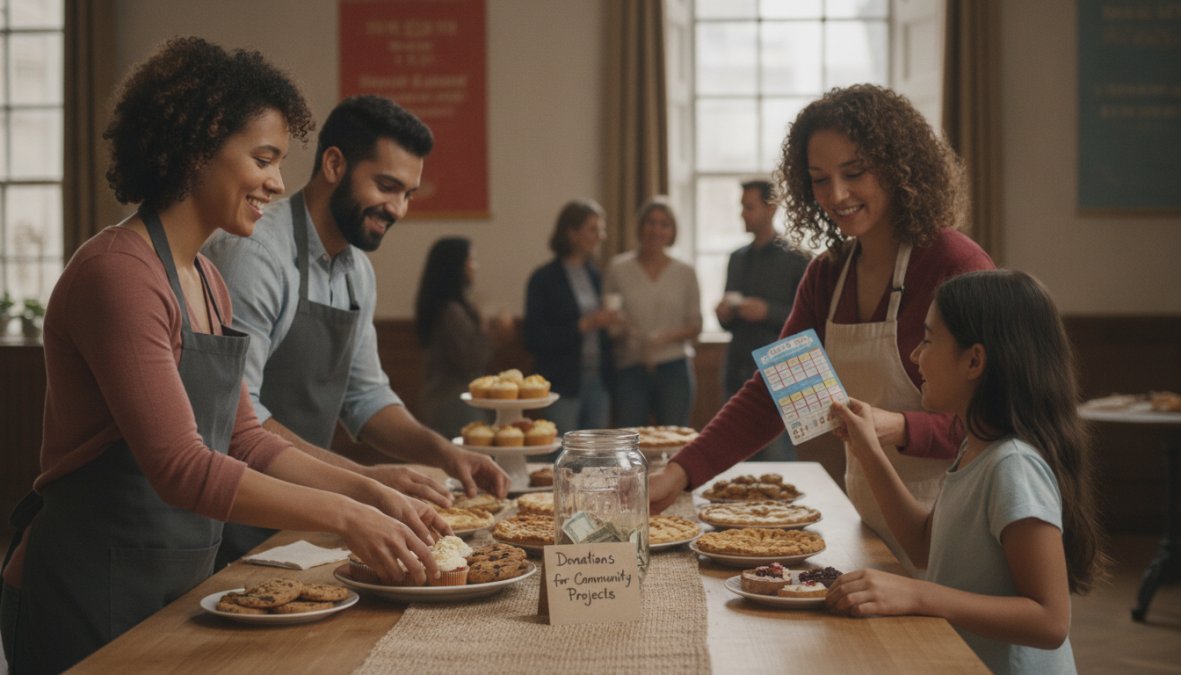
A bake sale is the simplest fundraising idea for busy volunteers because it requires almost no planning infrastructure. Ask each volunteer to bring 3-4 homemade items, set up a table in a high-traffic location, and price items at $2-5 each. Total volunteer time: 8-10 hours. Total revenue: typically $200-500 depending on foot traffic.
The secret to bake sale success is location. A table outside a grocery store on Saturday morning beats a table in an empty parking lot on Tuesday afternoon.
Trivia nights work similarly but with slightly more setup. Recruit a trivia host, prepare 60-80 questions, and charge teams $10-20 per person. What makes trivia nights appealing: donors aren't just giving money, they're having fun with friends, creating loyalty and repeat attendance.
Raffles and Silent Auctions: Low-Effort, High-Engagement
A raffle requires minimal volunteer coordination but generates excitement. Collect donated items or gift cards from local businesses and sell raffle tickets at $5-10 each. Silent auctions work on the same principle but with more perceived value. Items that cost the organization nothing, a catered dinner, a weekend getaway, a professional service, often fetch hundreds of dollars.
Fundraising Email Templates for Volunteers: Maximize Donor Engagement
Email remains the highest-ROI fundraising channel. A well-written email can generate $500-2,000 in donations with 30 minutes of work.
Creating Effective Call-to-Action Messages
The best fundraising emails follow a simple structure: story, ask, link.
Subject: Help [Organization Name] reach $[goal] by [date]
Hi [Donor Name],
We're raising $[amount] to [specific impact]. With your help, we can [concrete outcome by date].
Here's what your donation does:
- $25 funds [specific thing]
- $50 funds [specific thing]
- $100 funds [specific thing]
[DONATE NOW LINK]
If you can't give right now, forward this to someone who might.
Thank you, [Your name] [Organization name]
Donor Retention Strategies Through Simple Follow-Up
One email generates a donation. A sequence of emails generates a relationship. After someone donates, send three emails: a thank-you within 24 hours explaining how their gift will be used, an impact update within 2 weeks, and an event invitation within 2 months. Most donors who receive follow-up emails give again within 6-12 months.
How to Plan a Fundraiser in Under 10 Hours
A good fundraiser doesn't need to be perfect. It needs to happen.
The 10-Hour Fundraiser Checklist
Hours 1-2: Define your goal
- What are you raising money for? (Be specific: $2,000 for new equipment)
- When do you need the money?
- How many volunteers can you realistically recruit?
Hours 3-4: Choose your format
- Pick one idea that matches your timeline and volunteer capacity
- Decide if it's virtual or in-person
- Identify your venue or platform
Hours 5-6: Recruit and delegate
- Email volunteers with a one-page description
- Assign specific roles (three people maximum: organizer, treasurer, communicator)
- Set one all-hands meeting to align on details
Hours 7-8: Promote
- Create a simple one-page flyer or email announcement
- Share on social media and ask volunteers to share with their networks
- Send reminders 1 week before and 2 days before
Hours 9-10: Execute and follow up
- Run the event or campaign
- Send thank-you emails to donors within 24 hours
- Share results with volunteers and donors
Event Logistics and Volunteer Recruitment Made Simple
Volunteer recruitment fails when you ask too much of people. Instead of "Can you help with the fundraiser?" ask "Can you manage the registration table for 2 hours on Saturday at 10 AM?" Specific, bounded requests get better responses. Create a simple signup sheet with specific roles and time slots, and let volunteers self-select.
Fundraising Best Practices for Small Groups and Budget-Friendly Campaigns
Setting Realistic Fundraising Goals and Tracking ROI
A fundraising goal should be specific, achievable, and tied to a deadline. "Raise some money" fails. "Raise $3,000 by September 30" works.
Track ROI by comparing revenue to time invested. A bake sale generating $200 in 8 volunteer hours is $25/hour of value. A peer-to-peer campaign generating $1,500 in 15 volunteer hours is $100/hour of value.
Preventing Volunteer Burnout During Campaigns
Burnout happens when volunteers feel responsible for outcomes they can't control. Run shorter campaigns. A 30-day peer-to-peer fundraiser beats a 90-day campaign. Celebrate small wins. After the first week, send an email: "We've raised $500 toward our $3,000 goal. We're on pace to hit our target. Thank you."
Easy Fundraising Tools for Non-Profits: Scratch-Off Cards and Platforms
Why Scratch-Off Cards Outperform Traditional Methods
Scratch-off fundraising cards combine the fun of a lottery with the predictability of revenue. Donors buy a card for $5-10, scratch off a panel, and reveal a prize or discount. The organization keeps 70-100% as profit.
What makes scratch-off cards special: they create a moment of excitement. Unlike a donation form (which feels transactional), a scratch-off card feels like a game. A youth group selling 500 cards at $10 each (with $3 production cost per card) generates $3,500 in revenue. Volunteer workload is minimal: 1-2 hours to order, 2-3 hours to distribute cards, 3-4 hours to collect payment.
Comparing Fundraising Platforms: Matching Gifts and Recurring Giving
Givebutter is ideal for small teams. It's free to start, includes unlimited fundraising campaigns, and has built-in peer-to-peer fundraising. You can set up a campaign in 20 minutes.
Zeffy is truly free, no platform fees, no processing fees. For organizations that want to keep 100% of donations, Zeffy is unbeatable.
Double the Donation solves a specific problem: capturing corporate matching gifts. For organizations with donors at large corporations, this can increase revenue by 10-20% without extra effort.
| Platform | Best For | Key Strength | Setup Time |
|---|---|---|---|
| Givebutter | Small nonprofits | Intuitive, free tier | 20 minutes |
| Zeffy | Budget-conscious orgs | 100% free model | 15 minutes |
| Double the Donation | Corporate donors | Matching gift automation | 30 minutes |
Start with Givebutter or Zeffy. Both are free and easy.
School and Community-Based Fundraising Ideas That Scale
Sponsorships and Corporate Matching: Use Existing Resources
The simplest fundraising ideas often involve asking people who already have money to give it. A sponsorship is straightforward: a local business donates money in exchange for recognition. To secure sponsorships, identify 5-10 local businesses that align with your mission and make a specific ask: "Would you sponsor our event for $250? We'll display your logo on our materials and mention you in our social media."
Corporate matching gifts are even easier. A donor gives $100 to your organization. Their employer matches it with another $100. Double the Donation's matching gift database has over 30,000 companies with matching programs.
Social Media Campaigns for Community Outreach
A social media campaign costs nothing and can reach thousands of people. Post about your fundraising goal once per week for four weeks: Week 1 tells the story, Week 2 shows progress, Week 3 creates urgency, and Week 4 is the final push. Include a donation link in every post and ask volunteers to share with their networks. Volunteer time investment: 15 minutes per week.
The simplest fundraising ideas for busy volunteers aren't about finding shortcuts, they're about working smarter. Choose a campaign that fits your schedule, matches your donor base, and aligns with your team's strengths. Start small, measure what works, and build from there.
Frequently Asked Questions
What are the simplest fundraising ideas for busy volunteers with less than 5 hours?
Virtual peer-to-peer campaigns, online donation pages through platforms like Givebutter, and scratch-off card sales require minimal volunteer time. Scratch-off cards are particularly effective, volunteers simply distribute and collect, with no event coordination needed. Email campaigns with a strong call-to-action can also generate donations in under an hour of setup. These approaches let nonprofits raise money while volunteers manage other responsibilities.
How can I use fundraising email templates for volunteers to improve donor engagement?
Effective fundraising email templates should include a clear call-to-action, a brief story about your cause, and multiple giving options. Keep subject lines compelling and personalized when possible. Include donation links prominently and follow up with thank-you messages to boost donor retention. Pre-written templates save volunteers time while maintaining professionalism. Platforms like Givebutter and Donorbox offer customizable templates to streamline the process.
What's the best way to plan a fundraiser in under 10 hours?
Focus on low-logistics ideas: virtual campaigns, online auctions, or scratch-off card distribution. Spend the first 2 hours defining your goal and choosing a platform. Use 3 hours for volunteer recruitment and task assignment. Dedicate 3 hours to creating marketing materials and a simple social media campaign. The final 2 hours should cover final checks and contingency planning. Avoid complex in-person events that require extensive event planning and logistics coordination.
How do easy fundraising tools for non-profits like scratch-off cards compare to traditional methods?
Scratch-off cards offer up to 100% net profit with minimal volunteer effort compared to bake sales or car washes. They require no event logistics, no inventory management beyond distribution, and can be customized with your organization's branding. Fast turnaround, design approval and printing in days, means you can launch quickly. Volunteers simply distribute cards and collect funds, making them ideal for busy teams managing multiple responsibilities simultaneously.
How can small groups prevent volunteer burnout while running fundraising campaigns?
Distribute tasks evenly and set realistic timelines. Choose fundraising ideas that require minimal volunteer hours, virtual campaigns and scratch-off card sales are less demanding than multi-day events. Build in breaks and celebrate small wins to maintain morale. Use fundraising platforms that automate donor management and follow-up, reducing manual work. Clearly communicate expectations upfront and allow volunteers to opt into specific roles rather than overwhelming them with broad responsibilities.
This article was written using GrandRanker