

Profitable Fundraising Solutions for Churches: 2026 Guide
Table of Contents
- Profitable Fundraising Solutions for Churches: Quick Comparison
- High-Profit Scratch-Off Card Fundraisers
- Online Giving Platforms for Churches
- Church Capital Campaigns: Planning & Execution
- Small Church Fundraising Ideas with Limited Budgets
- Church Fundraising Best Practices: Legal & Compliance
- Community Events & Silent Auctions for Maximum Engagement
- How to Choose the Right Fundraising Solution for Your Church
Profitable Fundraising Solutions for Churches: 2026 Guide
Last Updated: July 22, 2026
Fundraising challenges affect nearly every faith community, from youth groups planning mission trips to congregations launching building campaigns. This guide breaks down the most effective and profitable fundraising solutions for churches that deliver results without burning out your team. Whether you're raising $500 or $50,000, the strategies below have been tested by real organizations and proven to work at scale.
Profitable Fundraising Solutions for Churches: Quick Comparison
| Fundraising Method | Setup Time | Profit Margin | Best For | Volunteer Intensity |
|---|---|---|---|---|
| Scratch-off cards | 1-2 weeks | Up to 100% | Quick cash, youth groups | Low |
| Online giving platforms | 2-3 days | 2-5% fees | Recurring donations, tithes | Minimal |
| Capital campaigns | 3-6 months | 40-60% | Major projects, building funds | High |
| Community events | 2-4 weeks | 30-50% | Engagement, local visibility | High |
| Silent auctions | 3-4 weeks | 45-65% | Donor relationships, large gifts | Medium |
| Peer-to-peer fundraising | 2-3 weeks | 50-70% | Mission trips, youth events | Medium |
High-Profit Scratch-Off Card Fundraisers
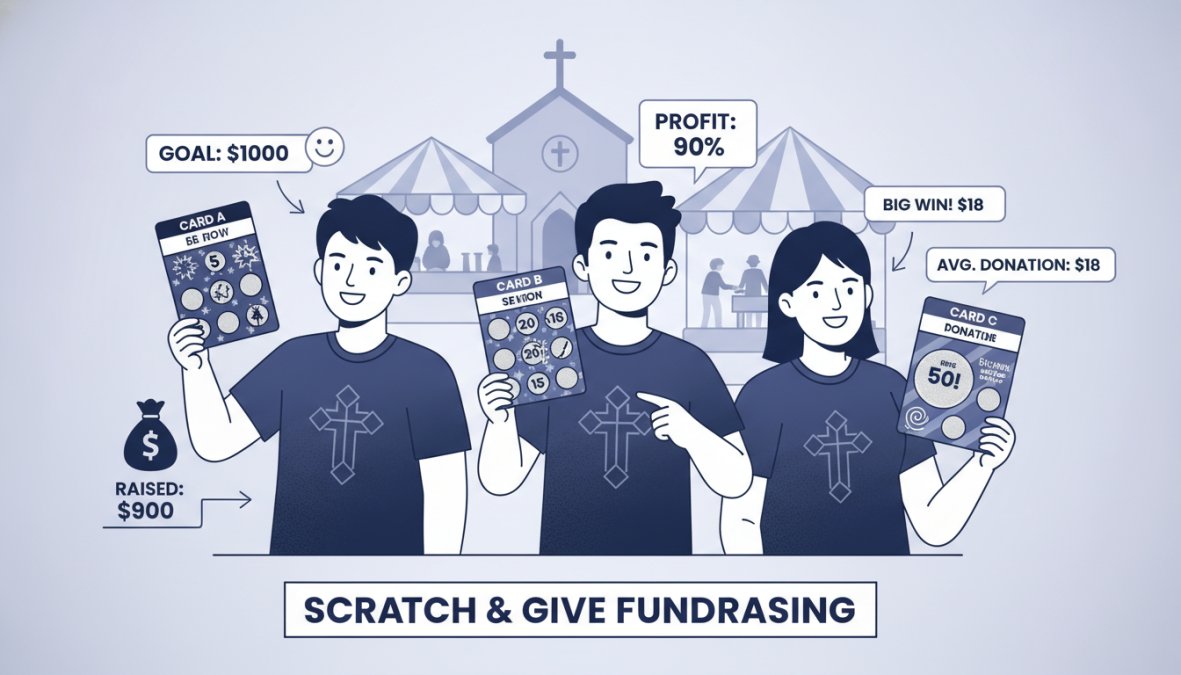
Scratch-off cards represent one of the simplest and most profitable fundraising solutions for churches because they require minimal ongoing management once launched. Unlike event-based fundraising that demands constant coordination, scratch cards work on a passive sales model where supporters buy cards and scratch them at their own pace.
Why Scratch Cards Deliver Up to 100% Net Profit
The profit potential of scratch-off cards comes from their fundamental business model: you set the retail price while the cost per card is minimal. If your cards cost $0.50 to produce and you sell them for $5, your gross margin is 90%. After accounting for design, printing, and shipping, organizations typically realize 70-100% net profit depending on order volume and pricing strategy.
Scratch & Give Fundraising specializes in customizable scratch-off cards with fast turnaround. Their design team completes proofs in one business day, and cards ship within two business days. This speed means you can launch a campaign in under three weeks instead of the six to eight weeks traditional printers require.
A bake sale might raise $300 with 40 volunteer hours invested. The same volunteer hours spent selling scratch cards can generate $2,000-$5,000 with minimal ongoing supervision required.
Real Results: Youth Groups Raising $5,000-$20,000
Organizations using scratch-off cards consistently report exceptional results. Young Warriors for Christ of Anderson Creek raised over $5,000 using this approach. President River Dell Jr Football documented raising $8,900 in just 10 days. Another youth organization achieved $20,000 in three weeks by combining card sales with peer-to-peer promotion through social media.
These results share common elements: clear fundraising goals communicated to volunteers, a defined sales window (typically 2-3 weeks), and easy inventory management. When volunteers know exactly how many cards to sell and why the money matters, conversion rates climb dramatically.
Online Giving Platforms for Churches
Digital giving has fundamentally changed how congregations collect tithes, offerings, and campaign donations. Today's donors expect the ability to give online, via mobile app, or through text message during services.
Recurring Giving & Donor Retention Features
Recurring giving transforms annual revenue predictability. Research shows that recurring donors contribute 42% more annually than one-time givers. When a donor sets up automatic weekly or monthly gifts, you gain both financial stability and increased lifetime value.
Platforms like Tithe.ly and Donorbox make recurring setup effortless. A donor can set up automatic giving in under 60 seconds using their phone during a service. The platform handles all billing reminders and failed payment recovery, removing administrative burden from your staff.
For capital campaigns, recurring gifts create a foundation layer. If 30% of your congregation commits to $20/month recurring gifts during a building campaign, that's guaranteed monthly revenue while pursuing larger one-time gifts from major donors.
Mobile & Text-to-Give Integration
Mobile giving is now expected. When a pastor mentions a need during service, 60% of attendees instinctively reach for their phone. Text-to-give services like Txt2Give cost nothing monthly and charge only 2.5% platform fees plus standard credit card processing. Donors text an amount to a keyword you provide, and the donation processes instantly.
Churches that implement both mobile and text-to-give channels see 18-30% increases in per-service giving within the first month.
Church Capital Campaigns: Planning & Execution
Capital campaigns for building projects, renovations, or debt reduction operate on completely different timelines and strategies than operational fundraising. These campaigns typically run 12-24 months and target major gifts rather than broad congregational participation.
Setting Realistic Fundraising Goals & Timelines
The first mistake most churches make is setting a goal without understanding their donor capacity. According to best practices, the most successful campaigns raise 60-70% of their goal from the top 20% of donors.
Your first task is identifying who your major donors are and what they've historically given. If your congregation has never given more than $5,000 per family, assuming you'll suddenly raise $100,000 from major gifts is unrealistic. Build your goal from actual capacity, not aspirational thinking.
Realistic timelines account for donor decision-making cycles. A major donor considering a $25,000 gift typically needs 3-6 months from first conversation to commitment. Successful campaigns allow 12-18 months minimum for major gift cultivation.
Stewardship-Based Approaches for Major Gifts
Stewardship is the practice of deepening donor relationships through gratitude, transparency, and impact reporting. It treats donors as partners in ministry rather than revenue sources.
This means providing quarterly impact reports showing how previous gifts were used, inviting major donors to see projects firsthand, and creating naming opportunities that honor their contribution. When donors see their $10,000 gift directly fund a youth mission trip or facility improvement, their likelihood of giving again increases by 60% or more.
Small Church Fundraising Ideas with Limited Budgets
Churches with fewer than 100 active members face real constraints: limited volunteer availability, minimal upfront capital, and difficulty achieving economies of scale. Yet small churches often have advantages large ones lack: tight community bonds, higher per-capita participation, and genuine relationships that drive giving.
Community Events That Require Minimal Upfront Cost
The best fundraising events for small churches use existing assets and volunteer skills rather than requiring cash investment upfront. A pancake breakfast uses your kitchen, volunteers' cooking skills, and donated ingredients from local businesses. Cost: under $100. Revenue potential: $800-$1,500.
A community service day, yard work, home repairs, or cleaning for elderly members, builds goodwill while raising funds. Participants collect pledges per hour worked. Cost: minimal. Revenue: $500-$2,000 depending on community size.
These events work because they require no upfront inventory investment, use existing resources, and generate participation that strengthens community bonds beyond just fundraising.
Volunteer Recruitment & Management Without Burnout
Small churches often fail at fundraising because core volunteers burn out. A single person managing event logistics, volunteer coordination, and donor communication for six months will quit, leaving the entire effort abandoned.
The solution is distributed responsibility. Assign specific roles: one person handles volunteer recruitment and scheduling, another manages logistics, a third handles communications. When three people share the load, each invests 5-10 hours instead of one person investing 40+ hours.
For scratch-off card campaigns, Scratch & Give Fundraising eliminates the complexity that typically causes burnout. You don't manage inventory, handle reprints, or chase down sales reports. The cards arrive ready to sell, and volunteers simply distribute and collect.
Church Fundraising Best Practices: Legal & Compliance
Many churches overlook the legal and regulatory requirements for fundraising, assuming nonprofit status covers everything. Understanding tax implications and compliance requirements protects your organization and donors.
Tax Implications & Nonprofit Reporting Requirements
Donations to 501(c)(3) churches are tax-deductible for donors, but only if your organization is properly registered and maintains current status. The IRS requires annual Form 990-N filings (for organizations under $50,000 annual gross revenue) or Form 990-EZ for larger organizations. Missing these deadlines can result in loss of tax-exempt status.
Fundraising revenue is generally not taxable income for the church, but unrelated business income may be. Most traditional church fundraisers (bake sales, dinners, auctions) qualify as related activities, but consulting with a nonprofit tax professional is wise for unusual fundraisers.
Donor records must be maintained for at least three years. When a donor gives $250 or more, you must provide written acknowledgment of the gift amount and confirmation of tax-deductibility.
Donor Privacy & Financial Transparency Standards
Donor information is confidential and should never be shared with third parties without explicit consent. Your donor database should be password-protected and accessible only to authorized staff.
Financial transparency builds trust. Annual financial reports showing how funds were spent should be available to congregation members upon request. For peer-to-peer fundraising campaigns, clearly communicate how funds will be used and provide progress updates.
Community Events & Silent Auctions for Maximum Engagement
Community events serve dual purposes: they raise funds and strengthen congregation bonds. Silent auctions specifically generate both engagement and significant revenue. Unlike live auctions that require an auctioneer and can feel high-pressure, silent auctions let donors bid at their own pace on items displayed throughout your venue.
The profit margin for silent auctions ranges from 45-65% depending on item sourcing. If you secure donated items (local business merchandise, services, artwork), your cost is minimal. Revenue comes entirely from bids.
Bid Beacon software simplifies the entire process, from setup to payment collection. You photograph items, input opening bids, and let the platform manage bidding and checkout.
Event Planning Checklist & Profit Margin Optimization
Successful events follow a predictable planning sequence. Six weeks before your event, secure your venue and set your date. Five weeks out, identify your fundraising goal and calculate required ticket sales or item donations. Four weeks out, recruit your core planning team and divide responsibilities.
Three weeks before, begin securing auction items and soliciting donations from local businesses. Two weeks out, finalize your volunteer team, create promotional materials, and set up online ticketing. One week before, confirm all logistics: catering, volunteer assignments, technology setup, and backup plans.
Many churches underprice events to maximize participation, then wonder why they don't hit revenue goals. A $35 ticket that costs $8 in food and $5 in overhead leaves $22 profit per person. To raise $5,000, you need 227 attendees, a much more achievable goal for most congregations.
How to Choose the Right Fundraising Solution for Your Church
Different situations call for different approaches. Choosing the right solution depends on three factors: your timeline, your budget, and your specific goal.
Matching Solutions to Your Timeline, Budget & Goals
If you have less than 4 weeks: Scratch-off cards are your best option. Scratch & Give Fundraising delivers cards within two weeks of approval, giving you two weeks to sell. Online fundraising campaigns and peer-to-peer fundraising also work in tight timelines.
If you have 4-12 weeks: Community events, silent auctions, and peer-to-peer campaigns are ideal. You have time to properly promote, recruit volunteers, and secure donations.
If you have 3-6 months or longer: Capital campaigns with major gift cultivation are appropriate. You have time to identify and approach major donors individually, provide stewardship, and build momentum.
For small budgets (under $500 upfront): Community events using existing facilities and volunteer skills, scratch-off cards (minimal upfront cost with high profit margin), or online giving platforms (many offer free tiers).
For medium budgets ($500-$2,000): Silent auctions, dinner events, or scratch-off card campaigns combined with digital promotion.
For large budgets and major goals ($50,000+): Capital campaigns with professional consulting, comprehensive online giving platforms with advanced features, and multi-channel campaigns combining events, major gifts, and recurring giving.
The most profitable fundraising solutions for churches combine multiple approaches rather than relying on a single method. A congregation might use recurring online giving for steady operational revenue, scratch-off cards for quick youth group fundraising, and a capital campaign for building projects. This diversified approach reduces pressure on any single fundraiser and engages different donor segments.
Choosing the right fundraising approach requires honest assessment of your situation, timeline, and capacity. If you need quick revenue with minimal volunteer burden, scratch-off cards deliver results that other methods can't match. Scratch & Give Fundraising's customizable cards, one-business-day design turnaround, and two-business-day shipping mean you can launch a campaign in under three weeks and generate substantial revenue with minimal ongoing management. Start with a clear goal, match it to the right strategy, and execute with focus.
Frequently Asked Questions
What are the most profitable fundraising solutions for churches?
Scratch-off card fundraisers consistently rank among the most profitable, offering up to 100% net profit with minimal ongoing costs. Online giving platforms with recurring donation features also drive sustained revenue. Capital campaigns for major projects can raise substantial funds when paired with stewardship-based approaches. The best solution depends on your timeline, volunteer capacity, and congregation size. Small churches often see quick wins with scratch cards, while larger congregations benefit from integrated online giving platforms combined with event-based campaigns.
How can small churches fundraise effectively with limited volunteers?
Small church fundraising ideas should prioritize low-touch, high-leverage solutions. Scratch-off cards require minimal volunteer management, members simply sell cards and return proceeds. Online giving platforms automate recurring donations, reducing manual work. Community events like bake sales or trivia nights need fewer hands when you leverage local business sponsorships. Focus on peer-to-peer fundraising, where members become advocates rather than event organizers. Digital platforms handle logistics, freeing volunteers to focus on donor relationship-building instead of inventory or event logistics.
What online giving for churches features drive the most donations?
Recurring giving options significantly increase lifetime donor value, studies show recurring donors give 42% more annually than one-time givers. Mobile and text-to-give capabilities boost impulse giving during services. Customizable giving pages for specific campaigns (mission trips, building funds, emergency relief) allow donors to direct their contributions. Donor management dashboards with giving history help stewardship teams follow up meaningfully. Multiple payment options, cards, ACH, digital wallets, reduce friction. Platforms offering 'cover the fees' options increase net revenue by allowing donors to absorb processing costs.
How long should a church capital campaign last?
Most church capital campaigns run 12-24 months, depending on the goal size and congregation capacity. Smaller campaigns ($50,000-$250,000) may complete in 6-12 months with focused effort. Larger campaigns ($1 million+) typically require 18-24 months to allow for research, planning, case development, and donor cultivation phases. The timeline should account for volunteer recruitment, training, and rest periods to prevent burnout. Professional capital campaign consultants recommend building in a 3-6 month planning phase before public launch to ensure readiness and maximize results.
What legal considerations apply to church fundraising?
Churches must comply with nonprofit tax laws, including proper documentation of donations for tax deduction purposes. Raffles and sweepstakes may require state licensing or permits, check your state's regulations. Charitable solicitation laws vary by state; some require registration before fundraising. Financial transparency is essential, maintain detailed records and provide donors with annual giving statements. If offering goods or services in exchange for donations (e.g., auction items, event tickets), ensure pricing reflects fair market value. Consult a nonprofit attorney or accountant familiar with your state's requirements to stay compliant.
This article was written using GrandRanker