

15 Low Effort Fundraisers for School Clubs (2026)
Table of Contents
- Why Low Effort Fundraisers Matter for School Clubs
-
15 Low Effort Fundraisers That Actually Work
- 1. Scratch-Off Cards: Maximum Profit, Minimal Effort
- 2. Online Donation Platforms: Zero Inventory, Full Control
- 3. Virtual Popcorn Sales: High Profit Without Door-to-Door
- 4. Gift Card Rebate Programs: Passive, Year-Round Revenue
- 5. Shopping-Based Fundraising: Completely Hands-Off
- 6. Pledge-Based Events: Fun Runs and Walk-a-Thons
- 7. Direct Online Donations: The Easiest Option
- Best Fundraising Apps for Schools and Club Management
- No-Cost School Fundraising Ideas for Budget-Conscious Clubs
- How to Plan a School Fundraiser Fast: A Step-by-Step Approach
- Fundraiser Email Templates for Parents: Maximize Participation
- Tax and Legal Compliance for School Club Fundraisers
- Post-Fundraiser Financial Reporting and Budget Planning
Last Updated: July 12, 2026
Why Low Effort Fundraisers Matter for School Clubs
School clubs face a consistent challenge: limited volunteer time and competing priorities. Traditional fundraisers demand weeks of planning and uncertain returns. Low effort fundraisers deliver real results without burning out your team. According to the National Center for Education Statistics, school clubs rely on fundraising for 40% of their operating budgets, making efficiency critical. Low effort fundraisers eliminate friction by automating sales, removing inventory management, or shifting to passive income models.
15 Low Effort Fundraisers That Actually Work
Finding the right fundraising method means matching your club's constraints with a solution that fits. The 15 fundraisers below are ranked by effort-to-return ratio.
1. Scratch-Off Cards: Maximum Profit, Minimal Effort
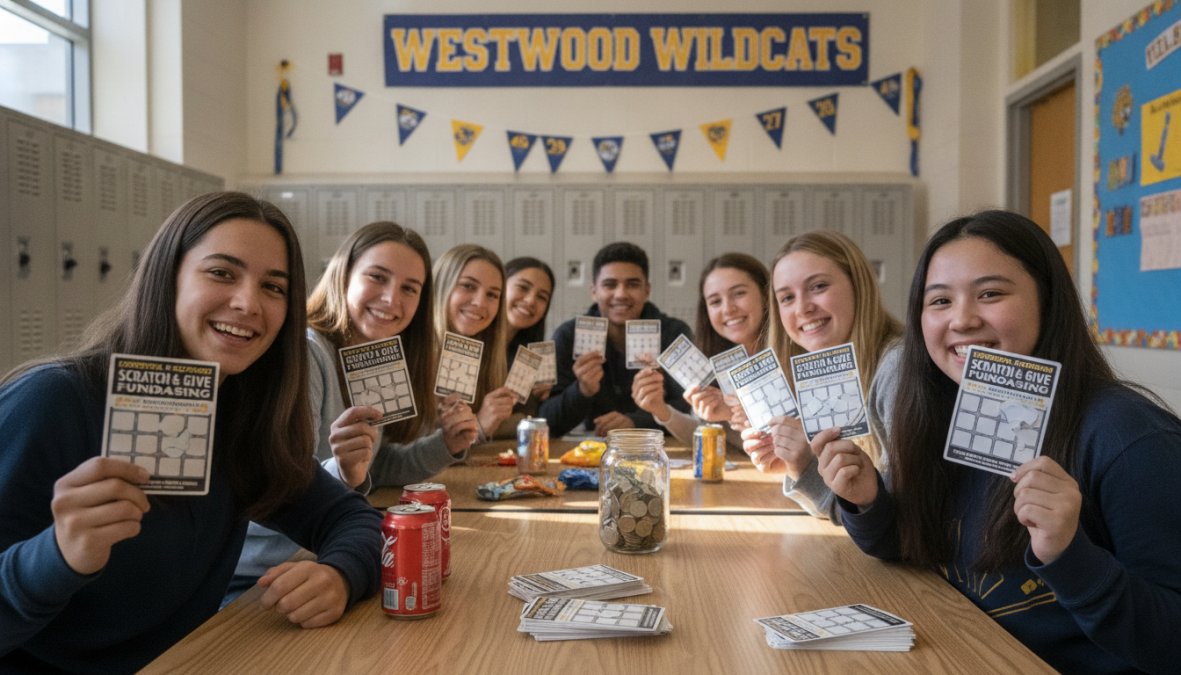
Scratch-off fundraising cards deliver high profit margins while requiring minimal ongoing management. Supporters purchase a card for $1-$5, scratch off a panel to reveal a prize or cash amount, and the organization keeps the difference. Unlike product-based fundraisers, there's no inventory to manage after the initial print run.
Scratch & Give Fundraising handles design with fast turnaround: proof approval in one business day and shipping within two business days. Customization options mean your cards reflect your school's colors, mascot, or club identity.
Effort Level: Low (setup only; distribution is self-service)
Profit Margin: Up to 100% net profit
Time to First Dollar: 1-2 weeks from order to first sales
Best For: Clubs with engaged parent networks or active student communities
Pros:
- Highest profit margins available
- No ongoing inventory management
- Fast design and production timeline
- Highly customizable to your brand
Cons:
- Requires upfront investment in printing
- Success depends on distribution network size
2. Online Donation Platforms: Zero Inventory, Full Control
Digital fundraising platforms eliminate the product entirely. Supporters donate directly to your cause through a custom donation page, removing all inventory and logistics complexity.
Zeffy is a completely free platform designed for nonprofits and student groups, eliminating platform fees entirely. Setup takes under 30 minutes: create a campaign page, add your club's story and fundraising goal, share the link via email or social media, and donations flow in automatically.
Effort Level: Very Low (setup only; completely passive after launch)
Profit Margin: 100% (no platform fees)
Time to First Dollar: Same day
Best For: Clubs with compelling stories or causes that resonate emotionally
Pros:
- Zero platform fees
- Completely passive once launched
- Built-in peer-to-peer fundraising tools
- Automated donor management and reporting
Cons:
- Success depends on storytelling and emotional connection
- Requires consistent promotion to maintain momentum
3. Virtual Popcorn Sales: High Profit Without Door-to-Door
Double Good transformed popcorn fundraising by removing the door-to-door model entirely. Supporters order gourmet popcorn online, and Double Good ships directly to their homes. Your club never touches inventory.
Students share a link with family and friends. Orders are placed online. Popcorn arrives directly to the buyer. Your club earns 50% of every sale. Setup takes less than an hour.
Effort Level: Low (setup and promotion only; fulfillment is automated)
Profit Margin: 50% per sale
Time to First Dollar: 5-7 days (shipping window)
Best For: Clubs with active student networks or strong social media presence
Pros:
- No inventory management
- No door-to-door sales required
- 50% profit margin is competitive
- Built-in gamification increases participation
Cons:
- Limited to popcorn products
- Time-bound events create pressure
4. Gift Card Rebate Programs: Passive, Year-Round Revenue
RaiseRight lets supporters purchase gift cards for retailers they already shop at, Target, Amazon, Starbucks, Home Depot, and hundreds more. Your organization earns a rebate on every purchase (typically 2-10% depending on the retailer).
The genius of this model is that it's completely passive. Supporters aren't making extra purchases; they're simply directing a percentage of their regular spending to your cause. A family that buys a $100 Target gift card might generate $3-5 for your club without changing their behavior.
Effort Level: Very Low (promotion only; completely passive after launch)
Profit Margin: 2-10% per transaction
Time to First Dollar: 30 days (typical payout cycle)
Best For: Clubs seeking sustainable, year-round fundraising without event-based spikes
Pros:
- Completely passive income model
- No selling or product pushing required
- Supports everyday spending habits
- Year-round fundraising potential
Cons:
- Lower profit margins per transaction
- Requires consistent promotion to generate volume
5. Shopping-Based Fundraising: Completely Hands-Off
ShopRaise turns everyday online shopping into fundraising. Supporters install a browser extension or use the mobile app. When they shop at over 1,000 retailers (Amazon, Walmart, Target, Sephora, Best Buy, and more), ShopRaise automatically directs a percentage of their purchase back to your organization.
You share a link or QR code with supporters. They install the extension once. From that point forward, every qualifying purchase generates funds automatically.
Effort Level: Minimal (one-time setup and initial promotion)
Profit Margin: 1-5% per transaction (varies by retailer)
Time to First Dollar: 30-60 days (payout cycle)
Best For: School clubs with large, digitally active parent communities
Pros:
- Completely passive after installation
- Integrates seamlessly with existing shopping habits
- Supports hundreds of major retailers
- Zero inventory or logistics complexity
Cons:
- Requires supporters to remember to use the extension
- Lower margins per transaction
6. Pledge-Based Events: Fun Runs and Walk-a-Thons
Pledge-based fundraising ties donations to a physical activity, a fun run, walk-a-thon, read-a-thon, or dance-a-thon. Supporters pledge a dollar amount per mile, page, or hour. PledgeStar specializes in pledge-based events with automated pledge collection and reminders.
Effort Level: Medium (event coordination required; platform handles collections)
Profit Margin: 93% (7% platform fee capped at $1,195)
Time to First Dollar: 1-2 weeks after event (payment collection window)
Best For: Clubs with active, health-conscious communities
Pros:
- Combines fundraising with physical activity
- Automated pledge collection and reminders
- High engagement and participation rates
- Builds community spirit and school pride
Cons:
- Requires event coordination and logistics
- Weather-dependent (outdoor events)
7. Direct Online Donations: The Easiest Option
The simplest fundraising method is also one of the most effective: ask for donations directly. Givebutter provides a modern donation platform specifically designed for schools and youth organizations. You can accept simple donations, run auctions, sell raffle tickets, or host virtual events, all from the same platform.
The donation experience is mobile-optimized. The free tier includes basic donation pages and reporting. Optional donor tips offset platform costs.
Effort Level: Very Low (setup and promotion only)
Profit Margin: 97-100% (depending on tip model)
Time to First Dollar: Same day
Best For: Clubs with compelling stories or causes that inspire emotional support
Pros:
- Simple, intuitive donation experience
- Mobile-optimized for modern supporters
- Flexible fundraising options
- Built-in CRM for donor management
- Fast setup (under 30 minutes)
Cons:
- Success depends on storytelling and emotional connection
- Requires consistent promotion
| Fundraiser | Effort Level | Profit Margin | Setup Time | Best For |
|---|---|---|---|---|
| Scratch-off cards | Low | Up to 100% | 1-2 weeks | Engaged parent networks |
| Online donations | Very low | 100% | 30 minutes | Emotional cause stories |
| Virtual popcorn | Low | 50% | 1 hour | Active student networks |
| Gift card rebates | Very low | 2-10% | 1 hour | Year-round passive income |
| Shopping fundraising | Minimal | 1-5% | 30 minutes | Large digital communities |
| Pledge events | Medium | 93% | 2-3 weeks | Active, health-conscious groups |
| Direct donations | Very low | 97-100% | 30 minutes | Compelling club stories |
Best Fundraising Apps for Schools and Club Management
Modern fundraising platforms fall into two categories: donation-focused (Zeffy, Givebutter) and product-focused (Double Good, RaiseRight). Donation platforms are simpler but depend on emotional storytelling. Product platforms are more complex but often generate higher absolute dollars.
Snap! Raise provides strategic support for high school athletic teams and large clubs. Their team helps design campaigns, manages email and text outreach, and provides real-time coaching. This service model means higher fees (typically around 20% of funds raised) but also professional guidance.
Effort Level: Low (platform and support team handle execution)
Profit Margin: 80% (20% platform fee)
Time to First Dollar: 1-2 weeks
Best For: High school sports teams with 50+ supporters and ambitious fundraising goals
MyBooster (Boosterthon) provides both a digital platform and optional on-site event support. Your club can run a campaign entirely through their platform, or invite their team to manage a live event at your school.
Effort Level: Low to Medium (depends on service level chosen)
Profit Margin: Varies by service level
Time to First Dollar: 1-3 weeks
Best For: Schools and large clubs running major fundraising events
No-Cost School Fundraising Ideas for Budget-Conscious Clubs
Not every club has budget for upfront investment. Bake sales, car washes, talent shows, and garage sales cost nothing to start but require significant volunteer labor.
Bake sales have profit margins of 70-80% but require substantial labor. Car washes can generate $150-300 in a 4-hour event with 6-8 volunteers, equaling $6-9 per volunteer-hour. Talent shows cost nothing if your club has performers and charge admission. Garage sales (collecting donations from supporters) have high margins (80-90%) but require significant coordination.
These methods work best when combined with low-effort alternatives. A club might run a bake sale quarterly, then supplement with gift card rebates year-round.
How to Plan a School Fundraiser Fast: A Step-by-Step Approach
When you need to raise money quickly, planning matters. A structured approach prevents delays and ensures execution.
Step 1: Define Your Goal and Timeline
Start with a specific target: "Raise $1,500 by March 15 for our state competition trip." Work backward from your deadline. If you need $1,500 in 4 weeks, that's $375 per week. Different fundraisers generate different weekly revenue, which affects feasibility.
Document your goal, deadline, and target weekly revenue. This becomes your planning anchor.
Step 2: Choose Your Fundraising Method
Match your constraints to the right method. Ask these questions:
Do we have budget for upfront investment? If yes, scratch-off cards or product-based fundraisers work well. If no, focus on donation platforms or activity-based methods.
How active is our supporter network? Large, engaged networks can sustain multiple channels. Small networks need to focus on one high-impact method.
How much volunteer time can we commit? Low-effort methods require minimal ongoing management. High-effort methods demand significant time but cost nothing.
For most school clubs, the best approach combines one primary fundraiser with one secondary, passive fundraiser.
Step 3: Set Up Volunteer Coordination
Assign clear roles: who handles design, who manages promotion, who coordinates distribution, who tracks progress. Create a shared spreadsheet that everyone can access. Weekly check-ins keep momentum and catch problems early.
Step 4: Launch Your Campaign and Track Progress
Start with email or direct messaging to your core supporters. Include a clear call-to-action, specific goal, and deadline. Follow up weekly with progress updates. "We're at $800 of our $1,500 goal, halfway there!" creates urgency and reminds supporters to take action.
Track metrics that matter: total revenue, participation rate, average donation/purchase size, and conversion rate. If a method isn't hitting targets by week two, be willing to pivot.
Fundraiser Email Templates for Parents: Maximize Participation
Email remains the most effective channel for fundraiser promotion. A well-written email drives 2-3x higher participation than social media alone.
Initial Announcement Email:
Subject: Help [Club Name] Reach Our $1,500 Goal, Easy Ways to Support
Dear [Parent/Guardian],
[Club Name] is raising money for [specific purpose: state competition, equipment, trip]. We've set an ambitious goal: $1,500 by March 15.
We're using a simple method that makes supporting us easy. [Choose one]:
- Purchase scratch-off cards for $1-5 each. Scratch to reveal a prize or cash amount. 100% of proceeds support our club.
- Make a donation through our online fundraising page. Every dollar goes directly to our goal.
- Purchase gift cards for retailers you already shop at. Earn rebates that support our club.
[Include direct link/QR code]
We've made this as easy as possible because we know you're busy. No door-to-door sales. No shipping delays. Just a simple way to support our students.
Thank you for believing in [Club Name].
[Club Name] Leadership
Weekly Progress Email:
Subject: We're at $[Amount], Help Us Cross the Finish Line
Dear [Parent/Guardian],
Great news: we've raised $[Amount] toward our $1,500 goal. That's [X]% of the way there.
We still need $[Remaining] by March 15. Here's how you can help:
[Include direct link]
Every purchase or donation moves us closer. Thank you for supporting [Club Name].
Final Push Email:
Subject: Last Chance, One Week Left to Support [Club Name]
Dear [Parent/Guardian],
We're one week away from our March 15 deadline. Current total: $[Amount].
We're $[Remaining] short of our $1,500 goal. If every family who hasn't yet participated contributes [specific amount], we'll hit our target.
[Include direct link]
This is your last chance to support [Club Name]. Thank you.
Tax and Legal Compliance for School Club Fundraisers
Fundraising creates tax and legal obligations that many school clubs overlook.
Tax Reporting: If your school club is part of a 501(c)(3) nonprofit (the school itself), fundraising proceeds are typically tax-exempt. Document all fundraising revenue and expenses. Keep receipts for supplies, printing, shipping, and platform fees.
Donor Privacy: Understand the privacy policies of any platform you use. Ensure you have a process for protecting donor data and following state privacy laws.
Liability and Insurance: Some fundraising methods create liability exposure. A pledge-based fun run, for example, involves physical activity. Ensure your school's insurance covers the event, or purchase event-specific liability insurance.
Approval and Oversight: Check your school's policies on club fundraising. Many schools require advance approval of fundraising methods. Submit your plan to your advisor or school administration before launching.
Financial Accountability: Keep detailed records of all funds raised and spent. Provide regular reports to your club members and school administration.
The safest approach is to work with your school's business office or club advisor. They understand local regulations and can guide you through compliance requirements specific to your district.
Post-Fundraiser Financial Reporting and Budget Planning
The work doesn't end when fundraising stops. Financial reporting and budget planning determine whether your fundraiser actually funded your goals.
Calculate Net Profit: Subtract all expenses (supplies, platform fees, shipping) from gross revenue. Net profit is what actually goes toward your club's purpose.
Track Participation Metrics: Document how many people participated and why. If 30% of your supporter base participated, that's useful information for future fundraisers.
Create a Budget: Decide how the funds will be spent. Communicate the budget to your members so they understand how their efforts translated into outcomes.
Plan for Future Fundraising: Use what you learned from this fundraiser to improve the next one. Document insights in a simple fundraiser report that your successors can reference. "Scratch-off cards generated $1,200 in 4 weeks with minimal volunteer effort. We recommend this as our primary fundraiser."
Last Updated: July 12, 2026
Low effort fundraisers for school clubs aren't just about saving time, they're about choosing methods that actually work. Scratch & Give Fundraising has helped youth organizations raise significant funds by providing customizable scratch-off cards with up to 100% net profit, fast design turnaround in one business day, and quick shipping within two business days. If your club has an engaged community and a clear deadline, scratch-off cards deliver results faster than most alternatives.
Start with a specific goal, choose a method that matches your constraints, and commit to consistent promotion. The clubs that succeed aren't the ones with unlimited volunteer time, they're the ones that choose smart, low-effort methods and execute them well.
National Center for Education Statistics on school funding
Frequently Asked Questions
What are the easiest low effort fundraisers for small school clubs?
The easiest low effort fundraisers include scratch-off cards (up to 100% profit with minimal management), online donation platforms like Zeffy (zero fees, completely passive), and shopping-based fundraising apps like ShopRaise (requires only sharing a link). These require no physical inventory, minimal volunteer coordination, and can be set up in days. Direct online donations through platforms like Givebutter also rank among the simplest options since supporters donate directly without selling products or managing orders.
How can school clubs raise money without selling products?
Non-product fundraising methods include direct online donations through fundraising platforms, pledge-based events like fun runs and walk-a-thons, gift card rebate programs (supporters earn rebates on everyday purchases), and shopping-based fundraising where supporters shop online through your organization's link. These methods eliminate inventory management, order fulfillment, and door-to-door selling while maintaining healthy profit margins. Many PTA and PTO groups find these approaches reduce volunteer burnout significantly.
What is the most profitable low effort fundraiser for school clubs?
Scratch-off cards offer the highest profit potential with up to 100% net profit after costs, depending on quantity and customization. Virtual popcorn sales through platforms like Double Good deliver 50% profit margins with zero upfront inventory costs. Both options require minimal ongoing effort once launched. The best choice depends on your timeline, scratch cards work well for quick turnarounds (design in one business day, shipping in two), while popcorn fundraisers typically run in short, time-bound windows.
How do you organize a successful fundraiser with limited time and volunteers?
Choose a platform-based fundraiser that handles most logistics for you: online donation platforms, virtual product sales, or shopping-based fundraising. Set a clear goal and timeline first, then select a method requiring minimal volunteer coordination. Use fundraiser email templates for parents to automate outreach and reduce manual communication. Leverage donor management tools built into platforms like Givebutter or Snap! Raise to track progress automatically. Assign one coordinator to monitor the campaign rather than requiring multiple volunteers for fulfillment or collection.
What fundraising platforms offer zero fees for school clubs?
Zeffy provides 100% free fundraising with zero platform fees, supported by voluntary donor tips. ShopRaise is free to organizations and supporters, earning revenue through retailer commissions. RaiseRight and SchoolStore operate on rebate models with no upfront costs. MyBooster and Givebutter offer free tiers with optional paid features. Before choosing, confirm the platform supports your fundraising method (direct donations, shopping, pledge events, or product sales) and integrates with your donor management needs.
This article was written using GrandRanker