

How to Raise Money for Youth Sports: 8 Proven Methods
Table of Contents
- Understanding Your Fundraising Goals and Timeline
- Fundraising Ideas for Youth Sports Teams That Generate Revenue
- Online Fundraising Platforms for Sports Teams
- Building Youth Sports Sponsorship and Local Business Partnerships
- Writing an Effective Sports Fundraising Letter Template
- Fundraising for Low-Income Families and Marginalized Communities
- Tax Compliance and 501(c)(3) Considerations for Youth Sports Fundraising
- Analyzing ROI: Which Fundraising Methods Actually Work
Last Updated: July 26, 2026
Understanding Your Fundraising Goals and Timeline
Before launching any campaign, know exactly what you're raising for and when you need it. Successful programs begin with math, not hope.
Calculating Your Target Amount
Your target should account for three categories: direct program costs (registration fees, equipment, coaching), travel expenses (transportation, lodging, meals), and a 10-15% contingency fund for unexpected costs. Breaking your total goal into smaller milestones makes the campaign feel manageable. If your team needs $8,000, frame it as four $2,000 goals across different methods. Document your calculation and share it with your team, transparency about where money goes builds trust and encourages participation.
Planning Your Campaign Timeline
Work backward from your deadline. If your team travels in April, launch fundraising by December or January. A realistic timeline allocates two weeks for planning, four to eight weeks for active fundraising, and one week for final push. Compressed timelines (less than six weeks) reduce revenue. Seasonal timing matters: holiday periods see higher giving but more competition; spring and early summer work well for sports fundraising.
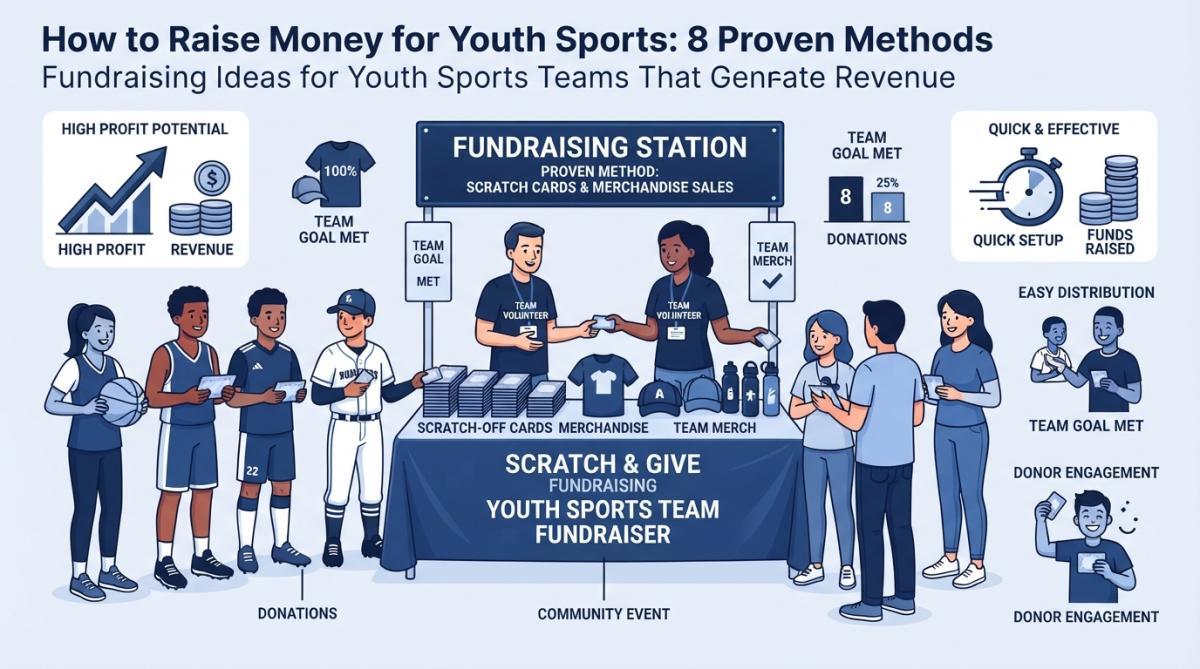
Fundraising Ideas for Youth Sports Teams That Generate Revenue
The most effective methods combine low barrier to entry with reasonable profit margins.
Scratch-Off Card Fundraisers
Scratch-off card fundraisers rank as the highest-profit method for youth sports teams. Cards cost roughly 50 cents to produce and sell for $5-$10. A team selling 500 cards at $5 each generates $2,500 in gross revenue with minimal labor. Customization with team photos or logos increases selling rates by 30-40%. Once distributed, your job is collection and accounting, no booth staffing, early mornings, or weather delays required.
Spirit Nights and Restaurant Partnerships
Partner with local restaurants where a percentage of sales (typically 10-20%) benefits your team. If 150 families spend $15 each, your team receives $225-$450. This requires zero upfront investment but works only in communities with sufficient family density. Success depends on aggressive promotion through email, social media, and flyers.
Gift Card and Scrip Fundraising Programs
Families purchase gift cards at face value from your organization; retailers give you a percentage discount (2-10% depending on retailer), and your team keeps the margin. A family buying a $50 Starbucks card from your team for $50 means Starbucks gives you a $5 commission. A team selling $10,000 in scrip at a 5% average margin generates $500 in net revenue. The friction point is that families must commit upfront.
Event-Based Fundraisers: Car Washes and Bake Sales
Car washes charge $10-15 per vehicle and take 15-20 minutes per car. With four volunteers working four hours, you might wash 40-50 cars and net $250-400 after supplies. Bake sales generate $300-600 in a four-hour shift. These work best as supplemental fundraisers, not primary revenue sources.
Walk-a-thons and Field Day Competitions
Participants collect pledges per mile walked or per event completed. Successful walk-a-thons generate $3,000-8,000 depending on team size and pledge commitment. The challenge is pledge collection, assign specific coordinators and set clear deadlines. Field day competitions add entertainment value by charging admission and selling concessions alongside pledges.
Apparel and Merchandise Sales
Selling custom apparel branded with your team name generates 40-60% margins. A team ordering 100 hoodies at $12 cost and selling them for $25 each grosses $2,500 with $1,200 profit. Online platforms like CustomInk and Bonfire simplify logistics. Merchandise sales work best when combined with events where team spirit is high.
Online Fundraising Platforms for Sports Teams
Digital platforms eliminate geographic limitations and enable recurring donations.
Crowdfunding Platforms and How They Work
Platforms like GoFundMe and Tiltify allow teams to create campaigns accepting donations from anywhere. Most platforms take 2-5% fees plus payment processing fees (typically 2.2% + $0.30 per transaction). Successful campaigns combine emotional storytelling with specific goals. "We need $5,000 for our spring tournament" works better than generic appeals. Include photos, explain what the trip means for athlete development, and show how donations directly support their experience.
Comparing Platform Features and Fees
| Platform | Platform Fee | Processing Fee | Best For |
|---|---|---|---|
| GoFundMe | 0% | 2.2% + $0.30 | General fundraising |
| Tiltify | 0% | 2.2% + $0.30 | Streaming/gaming communities |
| EveryKidSports | Varies | 2.2% + $0.30 | Low-income family support |
| Facebook Fundraisers | 0% | 1.5% + $0.20 | Social media-native campaigns |
The best platform depends on your team's comfort with technology and your audience. Facebook Fundraisers work well for teams whose families are already on Facebook.
Building Youth Sports Sponsorship and Local Business Partnerships
Sponsorships provide reliable, often larger revenue sources than individual fundraising methods.
Identifying Sponsor Prospects
List businesses your families frequent: restaurants, gyms, dental offices, auto shops, insurance agencies, and retail stores. Prioritize businesses owned by team families, they see direct impact and feel personal connection. Also identify youth-focused retailers and sports equipment companies with marketing budgets for youth sports sponsorship. Create a spreadsheet listing 20-30 prospects ranked by likelihood.
Creating a Sponsorship Proposal
A one-page proposal should answer: What are you raising for? How much do you need? What does the sponsor get? Specify sponsorship tiers: a $500 sponsor gets their logo on team uniforms and social media mentions; a $1,000 sponsor gets signage at games plus email recognition; a $2,500 title sponsor gets prominent branding and a social media feature. Include specific deliverables and impact statements. Follow up within one week, persistence significantly increases response rates.
Writing an Effective Sports Fundraising Letter Template
A well-written letter combines emotional appeal with specific details and clear calls to action.
Key Elements of a Persuasive Fundraising Letter
Open with a story, not a request. Begin with a specific moment showing growth, courage, or teamwork. The second paragraph explains what you're raising for and why it matters. The third paragraph explains how donations create impact with specific amounts tied to outcomes. The final paragraph includes a specific call to action with a deadline.
Dear [Name/Community],
Last month, I watched [athlete name] make a play that changed everything. [Specific moment describing growth, courage, or teamwork]. That moment crystallized why our team exists, to develop young athletes into confident, resilient people.
This spring, we're competing in the [tournament name] regional championship. This opportunity costs $4,000 for registration, travel, and coaching support.
Here's how your donation creates impact:
- $50 sponsors one athlete's registration fee
- $150 covers a player's transportation
- $300 funds two coaching sessions before competition
- $500 enables an additional athlete's full participation
We're raising funds through [specific methods] until [date]. Every contribution, whether $10 or $500, strengthens our program.
Thank you for believing in our team.
[Your name] [Team name] [Contact information]
Send via email and follow up one week before your deadline.
Fundraising for Low-Income Families and Marginalized Communities
Youth sports participation shouldn't depend on family income. Offer multiple participation pathways: some families donate money, others volunteer labor, others provide in-kind donations. All pathways contribute equally. Consider subsidy models, if 30% of families have financial constraints, allocate funds specifically to subsidize their registration and travel. Communicate clearly that fundraising is optional, not mandatory. Partner with community organizations serving low-income families to amplify reach while ensuring equitable participation.
Tax Compliance and 501(c)(3) Considerations for Youth Sports Fundraising
If your organization operates as a nonprofit, maintain clear records of all fundraising revenue and expenses for IRS Form 990. Understand donation deductibility, donors can only deduct donations to registered 501(c)(3) organizations. Be transparent about how funds are used. If you're fundraising as an unincorporated group, consult a tax professional about your tax obligations. Many youth sports organizations partner with established nonprofits or schools to gain 501(c)(3) status without forming a separate entity.
Analyzing ROI: Which Fundraising Methods Actually Work
Tracking Revenue and Expenses
Create a spreadsheet tracking each method: revenue, expenses, and net profit as a percentage of revenue. Also track volunteer hours and calculate revenue per volunteer hour.
Example:
- Scratch-off cards: $2,500 revenue, $300 expenses, $2,200 net (88% margin)
- Crowdfunding: $1,200 revenue, $75 fees, $1,125 net (94% margin)
- Car wash: $400 revenue, $100 supplies, $300 net (75% margin)
This reveals which methods generate the highest margins and efficiency.
Common Mistakes to Avoid When Raising Money for Youth Sports
Don't launch too many campaigns simultaneously, execute two methods well rather than five poorly. Order inventory conservatively and reorder if successful. Assign someone to manage follow-up through phone calls, emails, and direct asks. Communicate impact by sharing photos from tournaments and highlighting skills athletes developed. Treat fundraising as community building, not a chore, celebrate wins and recognize volunteer contributions.
Raising money for youth sports requires strategy. Scratch-off card fundraisers consistently deliver both reasonable profit margins and manageable volunteer demands, generating 80%+ net margins while requiring minimal ongoing management.
Scratch & Give Fundraising specializes in customizable scratch-off cards designed specifically for youth sports teams. With up to 100% net profit, one-business-day design turnaround, and two-business-day delivery, you can launch a campaign quickly. Teams using Scratch & Give Fundraising report raising $5,000-$20,000 per campaign, depending on team size and distribution effort. Start today and reach your fundraising goal faster than traditional methods allow.
Frequently Asked Questions
What are the easiest fundraising ideas for youth sports teams?
Scratch-off card fundraisers are among the easiest because they require minimal volunteer effort and can generate significant revenue with high profit margins. Spirit nights with local restaurants also rank high for ease, you partner with a business, promote the event, and the restaurant handles the logistics. Gift card and scrip programs work well too since families can purchase cards they'd use anyway. The key is choosing methods that align with your volunteer capacity and community preferences.
How do online fundraising platforms for sports compare to traditional methods?
Online crowdfunding platforms like GoFundMe and Tiltify offer convenience and reach beyond your immediate community, making them ideal for travel tournaments and large equipment purchases. However, they typically charge processing fees (2-3% plus payment processor fees). Traditional methods like scratch-off cards and spirit nights often deliver higher net profit percentages but require more hands-on volunteer management. Many successful teams use a hybrid approach: online platforms for broad reach combined with in-person fundraisers for community engagement and higher profit margins.
How much money should a youth sports team try to raise?
Start by calculating your actual expenses: registration fees, travel costs, equipment, coaching resources, and uniforms. Break this into per-athlete costs, then multiply by your team size. A small youth soccer team with 40 families might need $4,000-$8,000 annually, while travel tournament teams may need $15,000+. Set realistic campaign goals in phases rather than one large target. This keeps momentum high and allows you to adjust strategy based on early results. Track all team budget items to ensure your fundraising goal covers actual needs without over-raising.
What should I include in a sports fundraising letter template?
A strong fundraising letter should open with your team's mission and youth development goals, explain specific expenses (travel costs, equipment, coaching), include a clear ask with suggested donation amounts, and provide easy ways to contribute. Add social proof, mention past achievements or community impact. Include tax-deductible language if your organization qualifies as a 501(c)(3) non-profit. Close with gratitude and a clear call-to-action. Keep it to one page, use a professional template format, and personalize it when possible to increase donor retention and response rates.
This article was written using GrandRanker