

Best Fundraising Ideas for Church Mission Trips
Table of Contents
- Best Fundraising Ideas for Church Mission Trips: A Practical Overview
- Food-Based Fundraisers: Quick Revenue Generators
- Sales-Based Fundraisers for Church Mission Trip Fundraising Ideas for Youth
- Event-Based Fundraisers: Building Community Engagement
- Online Fundraising for Mission Trips: Digital Strategies That Work
- Mission Trip Fundraising Letter Template: Personal Outreach Approach
- Successful Church Fundraisers: Budget Planning and Financial Transparency
- Addressing Common Fundraising Challenges for Mission Trips
Last Updated: July 21, 2026
Best Fundraising Ideas for Church Mission Trips: A Practical Overview
When your church youth group needs to raise funds for an upcoming mission trip, finding strategies that generate real revenue without burning out volunteers is essential. This guide covers proven approaches that have helped mission teams raise anywhere from a few thousand to over twenty thousand dollars, with clear implementation steps and realistic revenue expectations.
Food-Based Fundraisers: Quick Revenue Generators
Food fundraisers work because they're straightforward to organize and people support causes when good food is involved. Success depends on keeping your menu simple, pricing strategically, and leveraging community appetite for convenience.
Pancake Breakfasts and Bake Sales
Pancake breakfasts deliver healthy profit margins when you keep food costs under $3 per serving and charge $8-$15 per plate. A typical pancake breakfast serving 75-150 people generates $500-$1,200 in a single morning.
Execute a successful pancake breakfast by choosing a venue with kitchen access, recruiting 8-10 volunteers for cooking and serving, promoting two weeks in advance through social media and church bulletins, and preparing ingredients in bulk the night before.
Bake sales require less labor. Set up at high-traffic locations and price homemade items at $2-$5 each. A well-executed bake sale generates $200-$500 depending on foot traffic.
Community Dinner Events
Hosting a spaghetti dinner or taco night creates a social atmosphere that encourages higher donations and premium pricing. Charge $12-$18 per plate, include a mission moment where team members explain why the trip matters, and offer add-ons like desserts and beverages to boost revenue.
A community dinner serving 100-150 people generates $1,500-$2,500 in a single evening. The emotional connection to your mission increases donations beyond meal costs.
Sales-Based Fundraisers for Church Mission Trip Fundraising Ideas for Youth
Sales-based fundraisers shift the burden from hosting events to selling products. These work particularly well for youth groups reaching peers and family through personal networks.
Garage Sales and Silent Auctions
Community garage sales leverage donated items with zero cost. Collect donations 3-4 weeks before the sale, price items at $0.50-$2 to move inventory quickly, organize by category, and promote through Facebook groups and local classifieds.
A well-executed garage sale generates $800-$2,000 depending on donation volume and quality. Mark down prices by 50% in the final hour to clear remaining inventory.
Silent auctions work similarly by soliciting donated items or services from local businesses. Display items with opening bid prices and let attendees write bids on cards. This approach works well at church events with a captive audience.
High-Profit Scratch-Off Cards
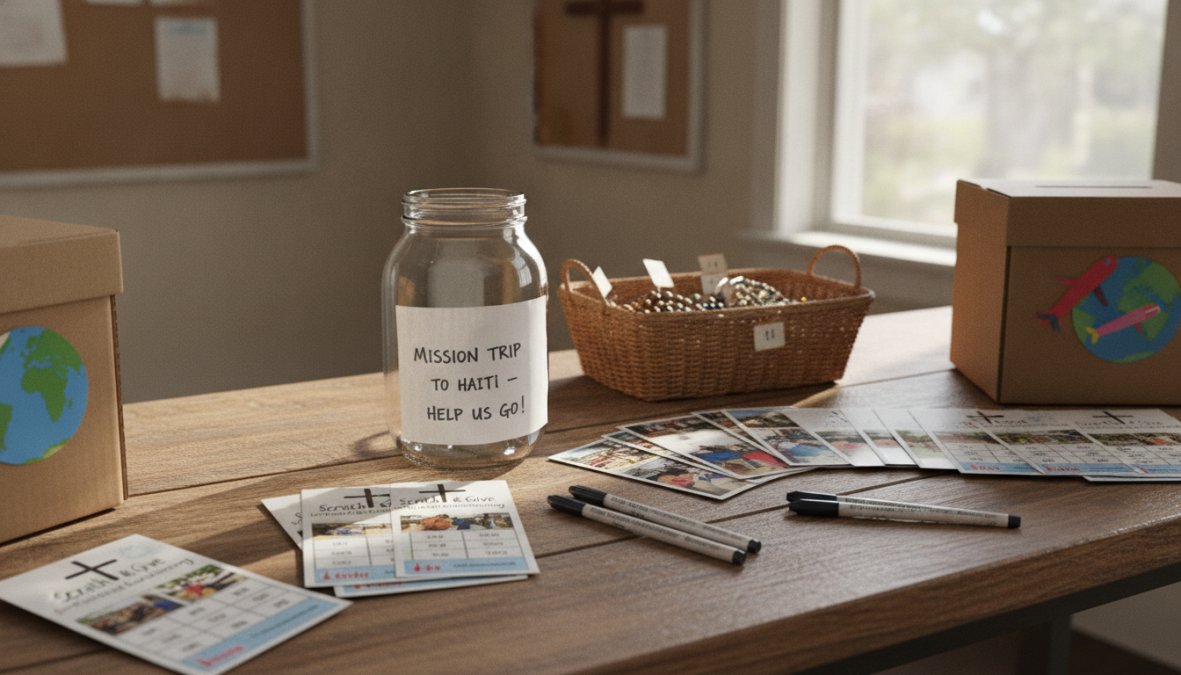
Scratch-off cards offer a fundamentally different model: supporters scratch to reveal hidden donation amounts ($5, $10, $20, $50) instead of attending events or buying products. This approach delivers exceptional profit margins up to 100% net profit with minimal inventory management.
Launch a scratch-off campaign by designing cards branded with your mission trip details, setting price points, distributing widely through church members and community events, and tracking sales on a simple spreadsheet. Fast design turnaround (one business day) and quick shipping (two business days) allow you to launch in under a week.
A youth group distributing 500 scratch-off cards at $5 each generates $2,500 in gross revenue with minimal effort. Teams using this approach report raising $5,000-$20,000 per campaign.
| Fundraiser Type | Setup Time | Profit Margin | Best For | Revenue Potential |
|---|---|---|---|---|
| Pancake Breakfast | 2-3 weeks | 60-70% | Small-to-medium teams | $500-$1,200 |
| Bake Sale | 1-2 weeks | 70-80% | Quick fundraising | $200-$500 |
| Community Dinner | 3-4 weeks | 50-60% | Community engagement | $1,500-$2,500 |
| Garage Sale | 3-4 weeks | 80-90% | Large inventory | $800-$2,000 |
| Scratch-Off Cards | 1 week | Up to 100% | Rapid fundraising | $2,500-$20,000+ |
Event-Based Fundraisers: Building Community Engagement
Event-based fundraisers create shared experiences that build excitement around your mission trip through participation and donations.
Walk-a-Thons and Car Washes
Walk-a-thons combine fundraising with visible, mission-focused activity. Have supporters pledge money per mile, recruit 20-30 walkers, collect pledges before the event, and make the walk social with water stations and encouraging signs. A walk-a-thon with 30 participants and $50 average pledges generates $1,500.
Car washes are simpler but have lower revenue ceilings. Set up in busy parking lots on Saturdays, charge $10-$15 per vehicle, and a team of 6-8 volunteers can generate $200-$450 in a few hours.
Movie Nights and Trivia Nights
Movie nights create low-pressure fundraising environments. Choose family-friendly films, charge $5-$10 admission, sell concessions at 40-50% markup, and include a brief mission moment before the film. A movie night attracting 80-100 people generates $700-$900 including concessions.
Trivia nights follow a similar model with team entry fees of $10-$15 per person, beverage and snack sales, and small prizes for winners. A well-attended trivia night generates $600-$1,000.
Online Fundraising for Mission Trips: Digital Strategies That Work
Online fundraising reaches supporters who can't attend in-person events and makes giving convenient regardless of location.
Crowdfunding Platforms and Social Media Campaigns
Crowdfunding platforms like GoFundMe, Donorbox, and Givebutter allow you to create a fundraising page that tells your mission story and accepts online donations. Write a compelling narrative with specific details, set a clear goal with a deadline, add photos and video testimonials, and share strategically across social media and email.
A well-executed crowdfunding campaign generates $2,000-$10,000 depending on network size and story quality. Post progress updates every 1-2 weeks and thank donors publicly. Social media campaigns amplify crowdfunding efforts through dedicated posts highlighting team members and sharing training updates with consistent hashtags.
Email Support Letters and Individual Asks
Email campaigns and direct asks remain highly effective. When supporters receive personal letters explaining your mission and requesting specific support, response rates significantly exceed generic appeals.
Craft effective support letters by opening with a personal story, explaining your specific fundraising need, suggesting donation amounts ($25, $50, $100, $500) and what each supports, providing multiple giving methods, and following up with thank-you notes and mission updates.
An email campaign to 100 supporters with $50 suggested donations might generate 20-30 responses totaling $1,000-$1,500. Individual in-person asks have even higher conversion rates.
Mission Trip Fundraising Letter Template: Personal Outreach Approach
Dear [Supporter Name],
I'm writing to invite you to be part of something meaningful. This summer, our youth group from [Church Name] is traveling to [Location] to serve alongside [Organization/Community]. We're going to [specific activities], and we need your help to make it possible.
[Personal story about why this mission matters]
To make this trip happen, we're raising $[total goal]. Your donation of:
- $25 provides [specific item or service]
- $50 provides [specific item or service]
- $100 provides [specific item or service]
Every dollar goes directly to our mission. You can give online at [link], by check, or by contacting me at [phone/email].
Thank you for believing in this work.
With gratitude, [Your Name]
Successful Church Fundraisers: Budget Planning and Financial Transparency
Success depends on clear planning and honest communication with donors. Calculate actual costs including venue rental, supplies, marketing, and a 10% contingency buffer. Work backward from your total trip cost to set realistic fundraising goals for each event.
Track expenses meticulously using a simple spreadsheet. This ensures you stay on budget and provides transparency when reporting results to your church and donors. Transparency builds trust and encourages repeat giving.
Ethical Considerations and Donor Stewardship
Be transparent about your mission's impact. Explain specifically what you'll do, who you'll serve, and how your work aligns with community needs. Partner with established organizations, listen to community voices about actual needs, prioritize local hiring and leadership, and maintain relationships with communities you serve.
Donors increasingly care about ethical dimensions. Demonstrating genuine partnership and respect encourages generous giving and recommendations.
Addressing Common Fundraising Challenges for Mission Trips
Prevent leftover inventory by ordering conservatively, setting clear deadlines, creating urgency, and distributing widely. Avoid volunteer burnout by spacing events strategically, varying work types, recruiting broadly, and celebrating progress.
Maximize ROI by choosing low-cost fundraisers first, using donated items and services, leveraging free marketing channels, negotiating bulk pricing, and tracking every dollar. Scratch-off cards offer exceptional ROI with no inventory waste and minimal upfront cost.
Mission trip fundraising doesn't require complicated planning or volunteer exhaustion. The most successful campaigns combine clear strategy, realistic planning, and genuine community engagement. Whether you choose food-based fundraisers, sales approaches, events, or online campaigns, executing well and staying focused on your mission is key.
Frequently Asked Questions
What are some unique fundraising ideas for a mission trip that don't require large events?
Scratch-off fundraising cards offer a unique, low-effort approach that generates high profit with minimal organizational overhead. Unlike large events, they require no venue rental or extensive volunteer coordination. Personal support letters, online crowdfunding through platforms like GoFundMe, and passive fundraisers like gift card rebates (RaiseRight) are also effective. These methods let donors contribute on their own schedule while you focus on mission preparation rather than event logistics.
How can I write an effective mission trip fundraising letter template?
An effective fundraising letter should clearly explain your mission's purpose, impact, and specific financial goal. Start with a compelling personal story about why this trip matters. Include the total amount needed and how donations will be used. Provide multiple giving options, online links (GoFundMe, Donorbox), check donations, or text-to-give. End with a specific call-to-action and thank-you. Keep it to one page, personalize when possible, and follow up with updates on your fundraising progress to maintain donor engagement and stewardship.
What's the fastest way to raise money for a church mission trip?
Scratch-off fundraising cards consistently deliver the fastest results, with some groups raising $8,900 in 10 days or $20,000 in 3 weeks. They require minimal upfront cost and can generate up to 100% net profit. Online fundraising through crowdfunding platforms also works quickly, you can launch immediately with no physical product. Combining a high-profit physical fundraiser (scratch cards) with digital outreach (social media, email support letters) accelerates results by reaching both in-person and online donors simultaneously.
How do I choose between different fundraising ideas for my youth group mission trip?
Consider your timeline, volunteer capacity, and community preferences. For quick fundraising with minimal effort, scratch-off cards excel. For building community engagement, events like pancake breakfasts or car washes work well. Online fundraising suits distributed teams or those with limited in-person availability. Evaluate upfront costs versus profit potential, some ideas require inventory investment while others are nearly free. Match your choice to your group's strengths: if you have strong personal networks, support letters work best; if you have active volunteers, events are ideal.
What should I include in a successful church fundraiser budget to ensure financial transparency?
Document all expenses: materials, printing, venue rental, permits, and volunteer supplies. Calculate your profit margin clearly, if scratch cards cost $5 and sell for $20, your net is $15 per unit. Track donations received versus goal progress publicly. Communicate budget breakdowns to donors showing how funds support the actual mission trip costs (travel, lodging, supplies). Include contingency funds (10-15% of goal) for unexpected expenses. Publish final reports showing total raised, expenses, and net funds allocated to the mission. This transparency builds donor trust and demonstrates stewardship of their contributions.
This article was written using GrandRanker